
On January 9, 2026, Alaa Mamdouh Akef, Assistant Professor at the School of Foreign Languages of Peking University and Egyptian scholar, was invited to attend International Symposium for Young Sinologists and Mutual Learning among Civilizations, jointly organized by the Center for Language Education and Cooperation under China’s Ministry of Education and Renmin University of China. Representing young Sinologists, Professor Akef Delivers Remarks at the Opening Ceremony, sharing his reflections on mutual learning among civilizations and the mission of Sinology.
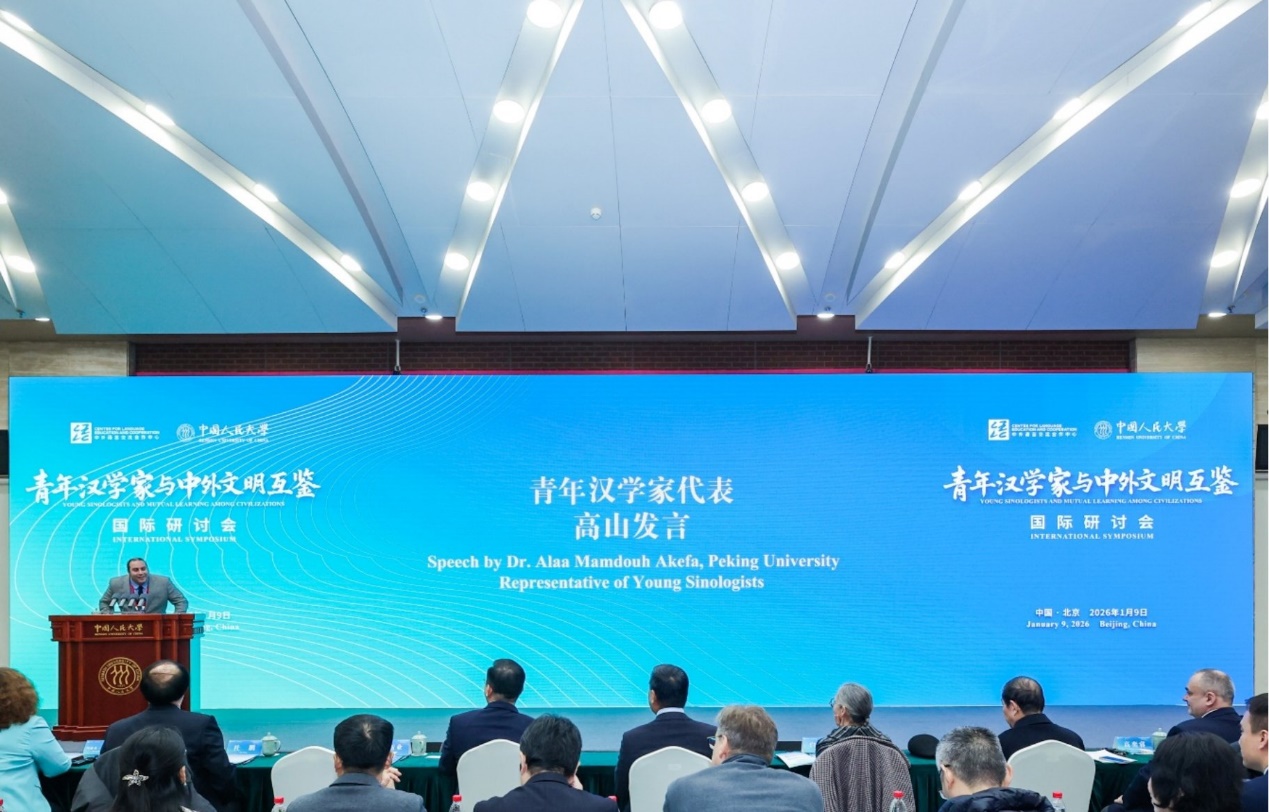
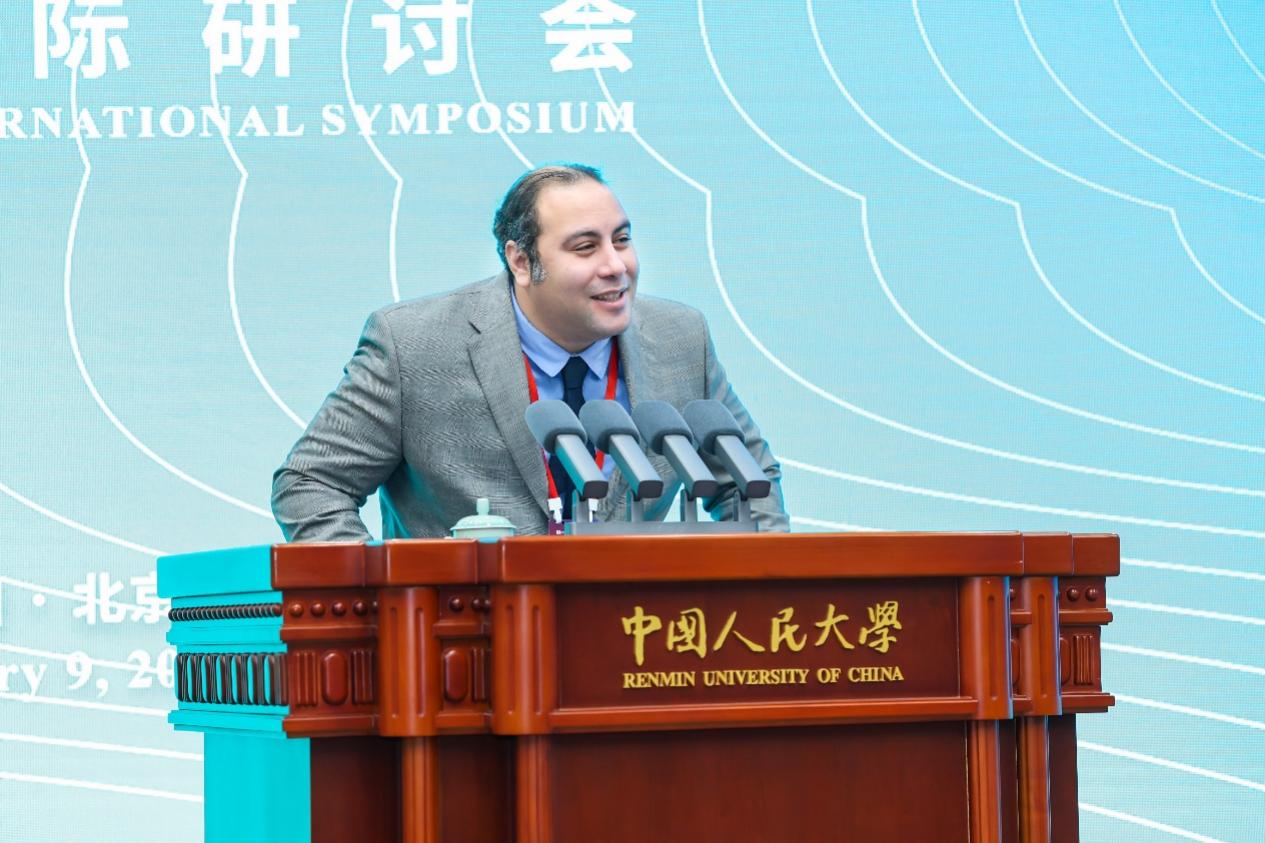
Professor Akef Delivers an Opening Speech
In his address, Professor Akef noted: “‘mutual learning among civilizations’ is not merely a personal story—it is about how an entire generation of young scholars can truly make an impact in cross-cultural exchanges.”
As one of the initiators of the joint letter sent by young Sinologists to President Xi Jinping during the 2025 World Chinese Conference, he emphasized that as Sinologists, “we are not only researchers of China but also participants in narrating China’s stories and shaping the ways in which dialogue takes place. Particularly in the face of the large number of emerging cultural concepts and online expressions in contemporary China, Sinologists should be equipped with ‘the ability to mediate and recast information across linguistic and cultural contexts’.” He argued that they must respect facts while being “bold enough to adjust communication strategies so that China’s stories are not only understandable, but also accessible, appealing and receptive to audiences.” As an expert in corpus and large language model research, Professor Akef pointed out: “no matter how advanced technology becomes, the quality of civilizational dialogue ultimately depends on the sensitivity to linguistic details, the grasp of historical context, and the calm judgment regarding real-world issues.”
From Cairo to Beijing, Professor Akef has been engaged in China–Arab civilizational exchange for over a decade. This “on-site” research and practice lasting more than a decade has convinced him that “Sinological research must be closely connected with China’s contemporary development and with civilizational interaction between China and other civilizations.” Scholars should immerse themselves in China’s living reality, obtain first-hand insights, and ground their academic work in authentic social contexts. When scholarship is closely aligned with reality, “research ceases to be mere classical interpretation confined to the scholar’s study; it becomes a long-term endeavor intertwined with China’s contemporary progress and with civilizational mutual learning.”
People’s Daily Overseas Edition covered International Symposium for Young Sinologists and Mutual Learning among Civilizations.

Translated by Qu Sizhe