
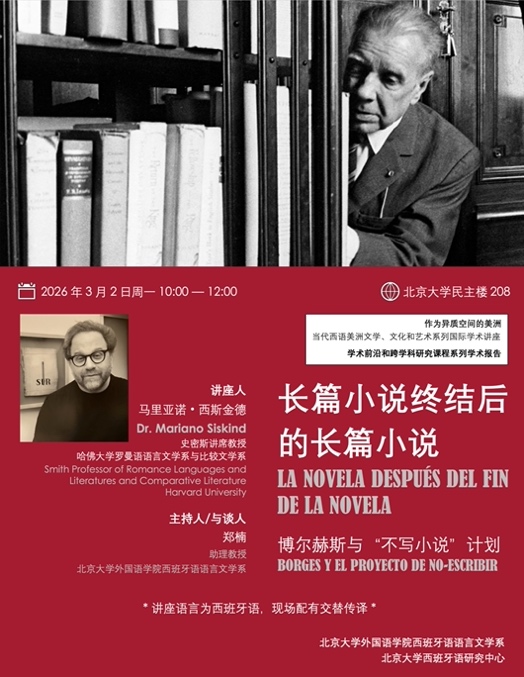
Lecture poster
On the morning of March 2, the Department of Hispanic Languages and Literatures at the School of Foreign Languages, Peking University, hosted the fifth session of the international academic lecture series "The Americas as Heterotopias: Series on Contemporary Hispanic American Literature, Culture and Art." At the invitation of Zheng Nan, Deputy Chair of the Department of Hispanic Languages and Literatures, Professor Mariano Siskind, the Smith Chair in Romance Languages and Literatures and Comparative Literature at Harvard University, delivered an academic lecture titled "The Novel After the End of the Novel: Borges and the Project of Non-Writing" for the department's faculty and students in Room 208 of the Minzhu Building.

Scene from the lecture
The lecture focused on the Argentine writer Jorge Luis Borges's rejection and reconstruction of the novel form. Professor Siskind noted that although Borges never wrote a novel, he engaged in profound critique of the genre through the "non-novel" approach. In this context, "non-writing" does not signify an absence but rather a literary practice grounded in negation: by fictionalizing, reviewing, or reconstructing non-existent novels, Borges not only challenged the classical paradigms of the novel but also re-examined the mechanisms behind the generation of literary meaning.
Professor Siskind noted that since the 20th century, in response to the aesthetic crisis of the novel, many Spanish-American writers have addressed this predicament through formal experimentation. There has long been a tradition in Latin American literature of writing "the novel after the end of the novel"—with Borges as its paradigmatic exponent. Drawing on short stories by Borges from 1933 to 1941, such as “The Approach to Al-Mu'tasim,” “Pierre Menard, Author of the Quixote” and “An Examination of the Work of Herbert Quain” and “The Garden of Forking Paths,” Professor Siskind further illustrated the specific practice of the "non-novel.” These texts often "represent" non-existent novels in the guise of book reviews, commentaries, or narratives, thereby blurring the boundaries among the novel, the review, and the essay. Through this method, literature ceases to be soely the author's creation and thus becomes an event centered on reading.
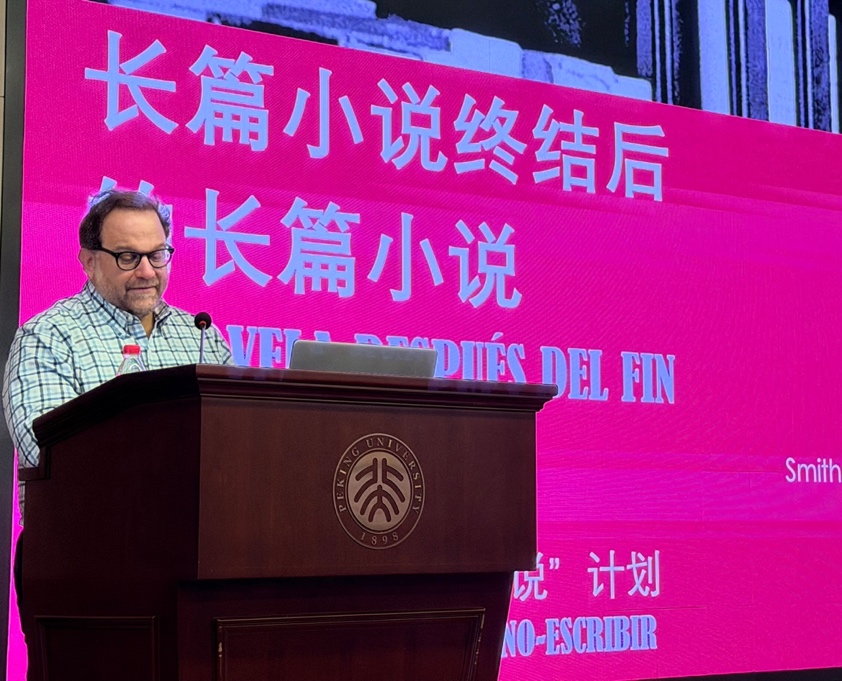
The Smith Professor delivering an academic lecture
Professor Siskind further analyzed this literary phenomenon from the dual perspectives of geopolitics and historical time. He pointed out that when the novel was introduced to Latin America from Europe, it played a vital role in shaping modern subjectivity and the imagination of national identity. However, as the historical contexts shifted, many writers came to recognize the limitations of the genre and sought breakthroughs through forms such as the anti-novel, the montage novel, and the non-fiction novel. In his essay “The Argentine Writer and Tradition,” Borges argued that Argentine writers can not only master national themes but also freely inherit the entirety of the Western cultural tradition—a marginal position that paradoxically affords writers greater room for innovation.
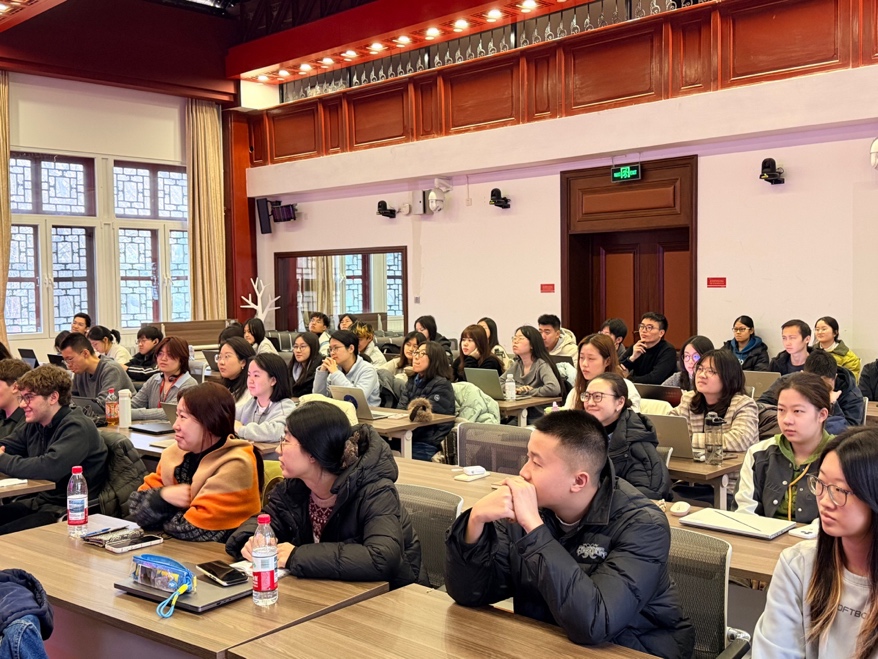
Faculty and students listening attentively to the lecture
At the conclusion of the lecture, Professor Siskind further explored the philosophical implications of the "non" in the "non-novel," linking it to Adorno's "negative dialectics." He argued that Borges did not offer a new paradigm for the novel but rather preserved its ghost amid the ruins of the genre, revealing the complex, unfinished relationship between literature and modernity through sustained negation: the "non-novel" reminds us to coexist with past forms in a fragmented modern culture and to continually reflect on their significance.
At the end, Professor Lu Yanping, Chair of the Department of Hispanic Languages and Literatures, presented a certificate of lecture to Professor Siskind, along with the lecture poster and souvenirs. Following this, all attending faculty and students gathered for a group photo to commemorate the occasion. The lecture successfully concluded in a warm and pleasant atmosphere.

Group photo of faculty and students after the lecture
Contributed by: Department of Hispanic Languages and Literatures, School of Foreign Languages, Peking University
Translated by Yifei Xing