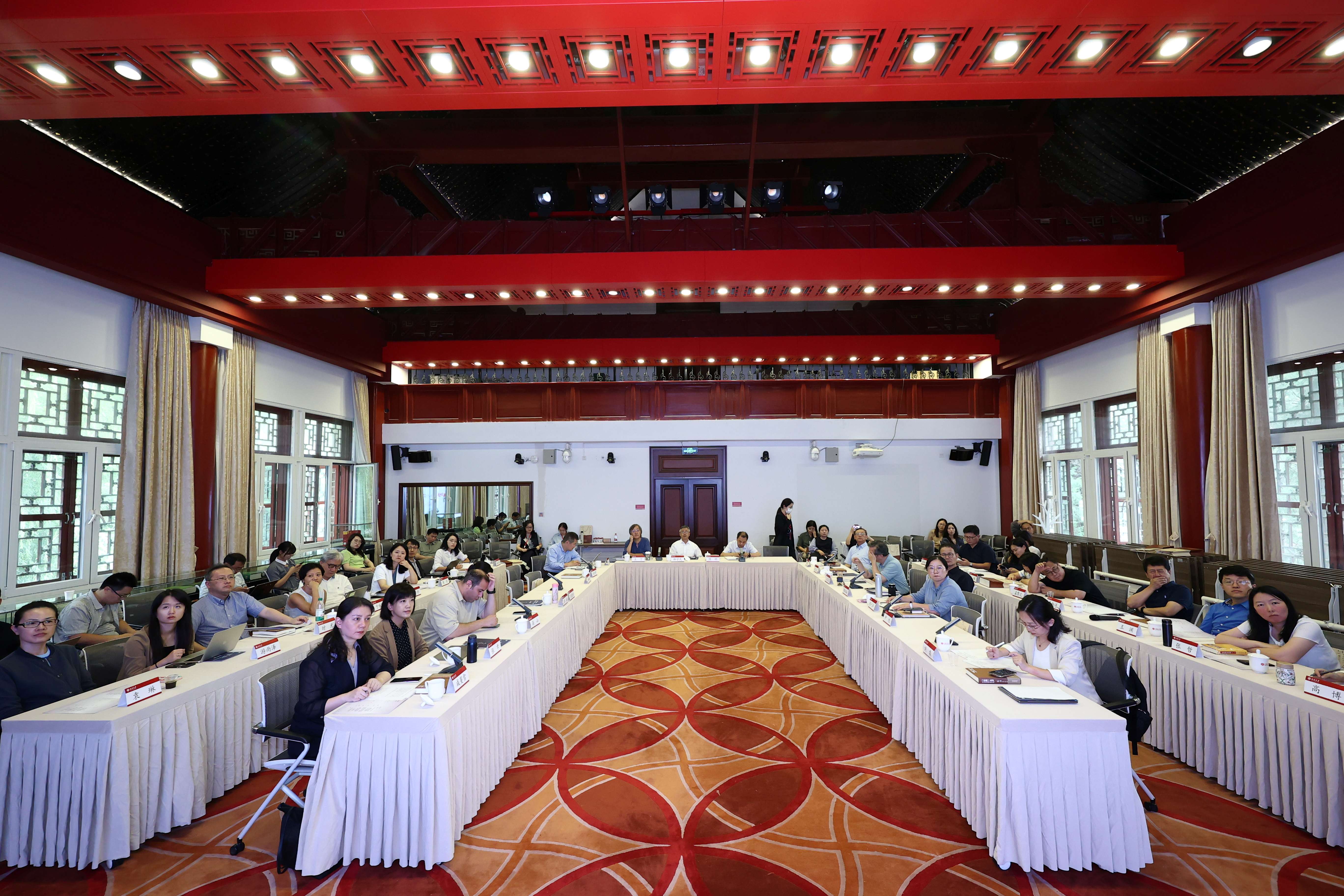
On September 13, the School of Foreign Languages, Peking University, hosted the launch ceremony of the Language Archive Initiative and the release of the new book Language Archive: The First Voice. The event was co-organized by Tianjin Education Press, the Research Center of Eastern Literature at Peking University, the Institute of Transcultural Studies of the Academy of Chinese Culture, and the Institute of Oriental Studies at Peking University. More than fifty experts and scholars from the Institute of Party History and Literature of the Central Committee of the Communist Party of China, Tianjin Publishing and Media Group Co., Ltd., as well as leading universities such as Peking University, Fudan University, and Zhejiang University, gathered at Peking University to engage in in-depth discussions on the compilation and translation of bilingual dictionaries, mutual learning among civilizations, and the construction of dictionaries in the context of digital humanities, and other frontier academic topics.
The Language Archive Initiative is guided by the principle of “passing down through generations and promoting mutual learning among civilizations.” It undertakes a comprehensive survey of linguistic materials, including extant bilingual dictionaries from China and abroad—encompassing relevant manuscripts, handwritten copies, and printed editions—as well as corpora of excavated documents, such as bilingual vocabulary manuscripts unearthed along the Silk Road. On the basis of compiling a full summary of catalogues, the Initiative regards all related dictionaries as an organic whole, exploring them through the lens of Chinese linguistic and cultural elements.

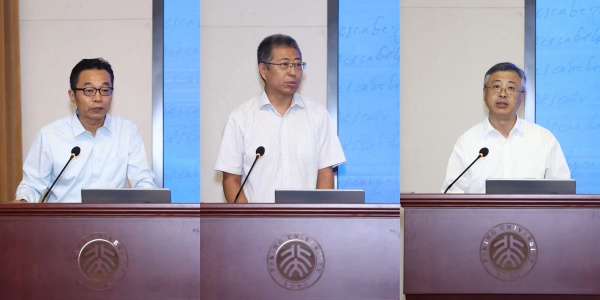
At the opening ceremony, Professor Chu Xiaobo, Director of the Office of Humanities and Social Sciences, Peking University, pointed out that the Language Archive Initiative aligns closely with China’s national cultural strategies. It represents an active endeavor to promote interdisciplinary integration between foreign language and literature studies, history, and digital humanities, and also serves as an important practice under Peking University’s “2025 Year of Scientific and Technological Innovation” Initiative. Mr. Zhang Yunfeng, Deputy General Manager of Tianjin Publishing and Media Group Co., Ltd., noted that the Initiative embodies both profound cultural foundations and academic depth. The publishing house will maintain long-term collaboration with the School of Foreign Languages, Peking University, to develop the Language Archive series into a high-quality collection that integrates the compilation of Chinese and foreign dictionaries and the study of dictionaries across different historical periods, and that connects the past and the present, the print and the digital resources—to build a scholarly treasury and a living archive of Chinese civilization. Mr. Qing Xuemin, Deputy Director of the Sixth Research Department of the Institute of Party History and Literature of the Central Committee of the Communist Party of China, emphasized that language is a carrier of civilization and a bridge for cultural exchange. Conducting systematic research on bilingual dictionaries is therefore of great significance for advancing the Belt and Road Initiative and enhancing people-to-people connectivity.

At the new book release ceremony, Professor Hu Zhuanglin,Emeritus Professor of Philosophy and Social Sciences at Peking University, extended his congratulations via video message on the publication of Language Archive: The First Voice. Professor Chen Ming , Dean of the School of Foreign Languages, elaborated on the value and significance of the Language Archive Initiative and reviewed its development from the conception to the launch. He stressed that the publication of Language Archive: The First Voice demonstrates the solid foundation and clear feasibility of the Initiative, marking an auspicious beginning for its future progress. Professor Xu Jun, Senior Professor of Liberal Arts at Zhejiang University, analyzed the significance of the Language Archive Initiative from three dimensions—wen (culture and literary heritage), zhi (knowledge and intellectual exploration), and si (reflection on the value of language learning).
During the keynote speeches, Professors Wang Kefei, Wang Ding, Gao Yongwei, Wen Xu, and Hu Kaibao shared their views, emphasizing that translation and bilingual dictionaries are mutually reinforcing and complementary. They noted that the compilation of multilingual dictionaries contributes to preserving and enriching the shared heritage of Chinese and foreign cultures, and they advocated leveraging advanced technologies to facilitate the implementation of the Language Archive Initiative. In the thematic speeches, Professors Shen Guowei, Qu Wensheng, Cheng Yiyang, Li Xuetao, and Wang Qilong traced the origins of the compilation of Chinese–foreign dictionaries, and through specific examples, explored new paradigms and directions in the studies of dictionaries. The roundtable forum brought together six scholars—Su Qi, Gao Shan, Yin Xu, Yu Jingsong, Shao Yonghai, and Hu Xuhui—who shared their latest research findings in areas such as the application of linguistic resources in the context of digital humanities and the use of AI to support the compilation of bilingual dictionaries.
At the closing ceremony, Ms. Guo Lin, Deputy Director of the Office of Humanities and Social Sciences, Peking University, remarked that the Language Archive Initiative will play an active role in advancing discipline development, scientific research, and talent cultivation. In his concluding speech, Dean Chen Ming emphasized that dictionaries are the crystallization of culture, and bilingual dictionaries serve as vital carriers for mutual learning among civilizations. He noted that the School of Foreign Languages will continue to promote the Language Archive Initiative, further exploring the cultural significance of dictionaries and contributing to China’s international communication and cultural exchange.
Translated by Xing Yifei